


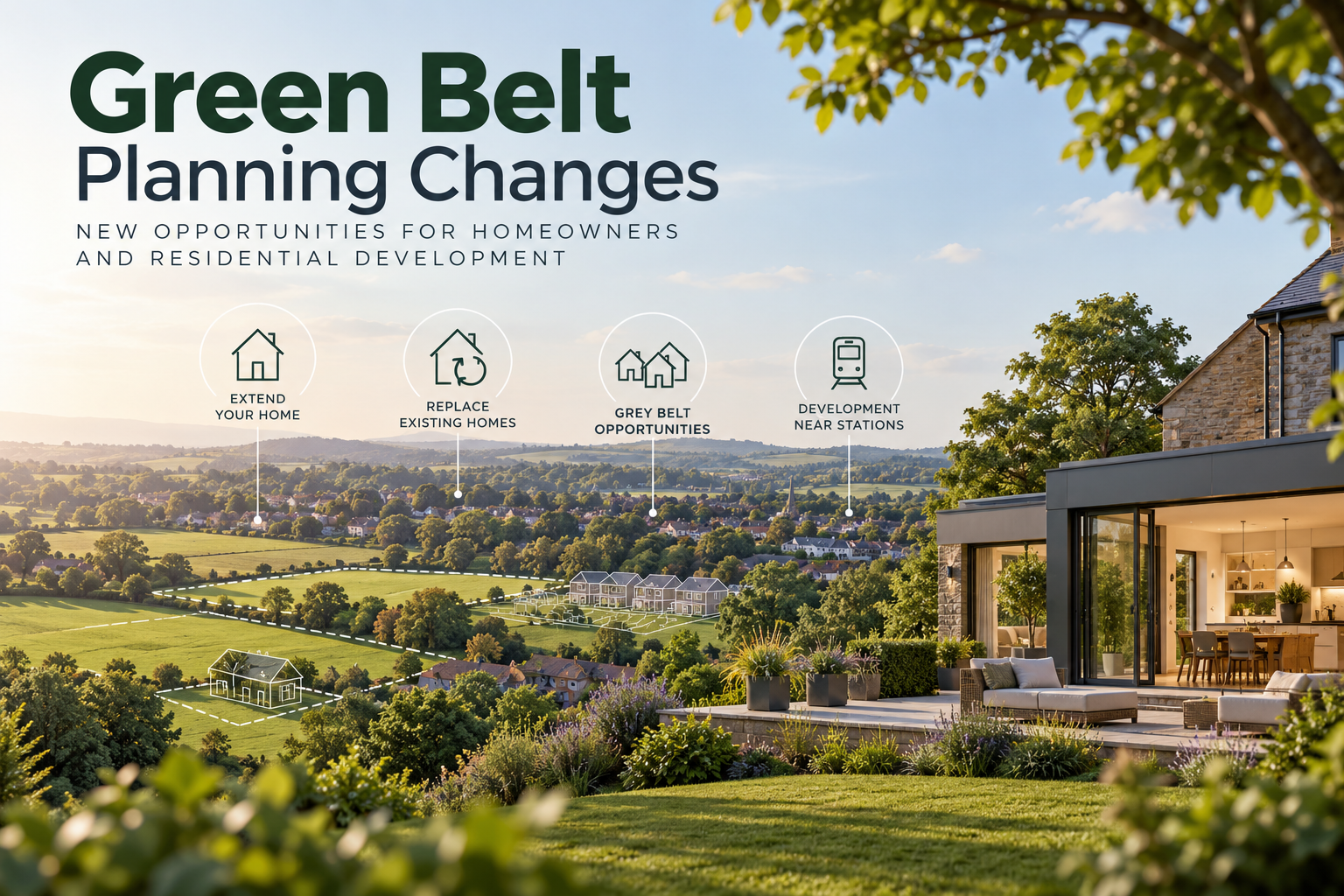
Green Belt Planning Changes:
The Potential Opportunities at a Glance
The latest National Planning Policy Framework (NPPF) introduces clearer routes for certain types of development in the Green Belt. Depending on your property or site, the changes could create opportunities to:
- ✅ Extend your existing home — explore larger rear extensions, side extensions and alterations where the proposal meets the relevant Green Belt policy tests.
- ✅ Replace an existing dwelling — consider a new home with an improved layout and design, subject to the restrictions on use and size.
- ✅ Investigate grey belt land — assess whether previously developed or other qualifying land could be suitable for residential development.
- ✅ Explore infill opportunities — investigate suitable sites within or adjoining existing built-up areas, where the relevant planning policies support development.
- ✅ Consider development near railway stations — certain well-connected locations may offer opportunities for residential or mixed-use schemes.
- ✅ Make better use of your plot — explore whether your property’s layout, existing buildings or available land could accommodate an appropriate development.
- ✅ Understand a clearer planning framework — use the revised national policies to assess your options and develop a more informed planning strategy.
The key takeaway: Green Belt designation does not automatically rule out development. The revised NPPF identifies specific circumstances in which development may be acceptable, but each proposal must satisfy the relevant policy requirements and other planning considerations.
At A P Architects, we can help you assess your property or site, identify potential opportunities and explore the most appropriate route forward.
Read on to discover what the changes could mean for your home, land or residential development project.
Could your Green Belt property have more potential than you think?
Understanding the latest National Planning Policy Framework (NPPF) changes and what they could mean for house extensions, replacement homes, infill development and new residential projects.
Green Belt land has long been associated with strict planning controls, leaving many homeowners uncertain about whether they can extend their property, replace an existing house or unlock the development potential of their land.
However, recent changes to the National Planning Policy Framework (NPPF) are creating a clearer, more targeted approach to development in and around the Green Belt.
The Government’s direction is clear: protect the essential purpose of the Green Belt while making better use of suitable land, supporting housing delivery and enabling appropriate development in sustainable locations.
For homeowners and property owners, this creates opportunities worth exploring.
At A P Architects, we believe the key is understanding how the new policies apply to your property, identifying what may be achievable and developing a well-considered design and planning strategy from the outset.
What has changed in Green Belt planning policy?
The revised NPPF, published in August 2026, builds on earlier reforms introduced in December 2024. The current framework provides more detailed policies for assessing Green Belt land, identifying opportunities for development and determining which proposals should be treated as inappropriate.
Importantly, Green Belt policy is no longer simply a question of whether land falls within a designated boundary. The nature of the land, its contribution to Green Belt purposes, the location of the proposed development and the relevant policy tests can all influence the outcome.
Three areas are particularly important:
- Greater clarity for existing homes: national policy identifies circumstances in which extensions, alterations and replacement buildings are not considered inappropriate development.
- A more targeted approach to grey belt land: suitable sites that make a limited contribution to certain Green Belt purposes may offer opportunities for residential development.
- Greater support for development in sustainable locations: the framework provides for certain residential and mixed-use development around well-connected railway stations, subject to specific conditions.
Let’s look at what this means in practice.
1. Can you extend a house in the Green Belt?
One of the most relevant provisions for homeowners is NPPF Policy GB7(b).
This policy states that the extension, alteration or reuse of an existing building can be considered not inappropriate development in the Green Belt, provided the building is lawful in planning terms and of permanent and substantial construction.
For extensions and alterations, the proposal must not result in a disproportionate increase in size compared with the original building.
This is an important distinction. A property being in the Green Belt does not, by itself, mean that extending it is prohibited.
What could this mean for your home?
Depending on the property and its planning history, opportunities worth investigating may include:
- A larger rear extension to create an open-plan kitchen, dining and family space.
- A side extension to provide additional living accommodation.
- A first-floor extension or carefully designed additional storey.
- A loft conversion or roof alteration.
- A comprehensive redesign of the existing house to improve its layout and functionality.
These are potential project types, not automatic planning entitlements. The size of the proposed extension, its relationship to the original house, its visual impact and other planning considerations will all need to be assessed.
Why good architectural design matters
In Green Belt locations, the argument is not simply about how much additional floor space you want.
A successful proposal needs to demonstrate that the extension is proportionate, respects the character of the original building and responds appropriately to its surroundings.
At A P Architects, we can help assess the existing property, explore alternative design approaches and develop a proposal that makes the best possible use of the available space while addressing the relevant planning policies.
Thinking about extending your Green Belt property? An early assessment can help establish which options are worth pursuing before you commit to a full design.
2. Grey belt: could your land have residential development potential?
The term grey belt has become an important part of the planning conversation.
Under the current NPPF glossary, grey belt includes Green Belt land comprising previously developed land and/or other land that does not strongly contribute to certain Green Belt purposes.
These purposes relate to:
- Checking unrestricted urban sprawl.
- Preventing neighbouring towns from merging.
- Preserving the setting and special character of historic towns.
The definition is set out in NPPF Policy GB2 and Annex B.
The key point is that not all Green Belt land performs the same role. Some sites may make a more limited contribution to the purposes of the designation than others.
What types of sites could be worth investigating?
Depending on their location and circumstances, potential opportunities might include:
- Previously developed land, including suitable former commercial or other developed sites.
- Underused sites on the edge of existing settlements.
- Land adjoining established development where its Green Belt contribution may be limited.
- Sites close to public transport and local services.
- Land that could accommodate development without undermining the wider function of the remaining Green Belt.
However, a site does not become suitable for development simply because it appears neglected, contains existing buildings or is described as grey belt.
The authority must consider the relevant Green Belt purposes, the sustainability of the location, development needs and the other applicable planning policies.
What does this mean for landowners?
If you own land within the Green Belt, it may be worth investigating its planning potential rather than assuming that development is impossible.
A professional assessment can help establish whether the site may qualify as grey belt, whether the relevant policy conditions can be met and whether a planning application or a longer-term promotion through the local plan process is the more appropriate route.
For landowners considering residential development, understanding these issues early can help inform investment decisions and avoid unnecessary expenditure on an unsuitable proposal.
3. Replacing an existing house: an opportunity worth exploring
Some Green Belt properties are older, poorly configured or no longer suited to modern living.
In the right circumstances, replacing an existing dwelling may offer a practical alternative to extending an unsuitable building.
NPPF Policy GB7(b) identifies the replacement of an existing building as a category of development that is not inappropriate, provided the relevant requirements are met.
For replacement buildings, the proposal must be for the same use and the new building must not be materially larger than the one it replaces.
This can create an opportunity to explore a more efficient layout, improved internal accommodation and a contemporary design that responds to the site.
However, replacement schemes still require careful consideration of matters such as the original building’s lawful status, scale, siting, design, landscape impact and any other relevant planning constraints.
A replacement dwelling is not an automatic route to a substantially larger house. The detailed circumstances of the site and the proposal remain crucial.
At A P Architects, we can help assess whether extending, altering or replacing an existing property is likely to offer the most appropriate design and planning approach.
4. Residential development on suitable Green Belt land
For landowners and developers considering more than a single-house project, the revised framework also provides routes for certain residential schemes on suitable Green Belt sites.
Two provisions are particularly relevant.
Grey belt development — Policy GB7(g)
Development on grey belt land may be considered not inappropriate where all the relevant conditions are satisfied.
These include:
- The development would not fundamentally undermine the purposes of the remaining Green Belt when considered across the plan area.
- There is evidenced unmet need for the type of development proposed.
- The site is in a sustainable location, with particular reference to transport policy.
- Major housing development complies with the applicable Golden Rules under Policy GB8.
This creates a potential route for residential development where a site and proposal satisfy the national policy tests.
Development around well-connected stations — Policy GB7(h)
The framework also identifies circumstances in which residential or mixed-use development around a well-connected railway station may be considered not inappropriate.
The proposal must be within reasonable walking distance of the station, be physically well related to the station or settlement, be of an appropriate scale for the available infrastructure and avoid prejudicing long-term comprehensive development proposals.
Major development must also satisfy the applicable Golden Rules.
For suitable sites, this provides an opportunity to consider housing in locations with access to public transport, employment and services.
For developers and landowners, the practical message is to assess the actual planning characteristics of a site rather than relying solely on its Green Belt designation.
5. The Golden Rules: what developers need to know
The opportunities for major residential development come with corresponding obligations.
NPPF Policy GB8 sets out the Golden Rules for major housing development on land released from the Green Belt through plan-making or on relevant sites within the Green Belt brought forward through a planning application.
The requirements cover three main areas:
Affordable housing
Development must meet the applicable affordable housing contribution requirements. Where the specified development plan policies are not yet in place, the framework provides a transitional approach, generally involving a contribution 15 percentage points above the highest otherwise applicable requirement, subject to a 50% cap. A 50% contribution applies by default where there is no pre-existing affordable housing requirement, subject to the detailed policy provisions.
Infrastructure
The development must contribute towards necessary local or national infrastructure improvements.
Accessible green space
Schemes must provide new public green space or improve existing accessible green space, helping create better places for residents and supporting nature recovery.
These requirements mean that a site’s development potential must be considered alongside its infrastructure, affordable housing and green-space obligations.
For developers, early feasibility work is essential to understand the relationship between the proposed scheme, the policy requirements and the overall deliverability of the project.
6. Green Belt development still needs a planning strategy
While the revised framework creates opportunities, it does not remove Green Belt protection.
Policy GB6 confirms that development in the Green Belt is inappropriate unless it falls within one of the categories identified by Policy GB7. Inappropriate development remains subject to the very special circumstances test, with substantial weight given to Green Belt harm, including harm to openness.
Other planning considerations can also affect the outcome. These may include:
- The character and appearance of the area.
- Neighbouring properties and residential amenity.
- Highway access and parking.
- Landscape, trees and biodiversity.
- Flood risk and drainage.
- Heritage assets and their settings.
- The site’s relationship with existing settlements and public transport.
A proposal that meets one Green Belt policy test must still be considered against other relevant development plan policies and material planning considerations.
This is why a site-specific assessment and a carefully developed design are so important.
How A P Architects can help
Whether you are a homeowner planning an extension, considering replacing an existing dwelling or investigating the potential of a residential development site, understanding the planning position is the first step.
At A P Architects, we provide architectural services for residential projects, helping clients move from an initial idea towards a considered design and planning proposal.
Our approach can include:
- Initial feasibility: reviewing the property, site constraints and relevant planning policies.
- Design development: exploring practical layouts, scale and architectural options.
- Planning strategy: identifying the key policy issues that need to be addressed.
- Planning drawings and supporting information: preparing a suitable submission for the project.
- Application support: helping develop a clear, coherent proposal for consideration by the local planning authority.
Every property and site is different. We do not assume that a Green Belt project will automatically receive permission; instead, we focus on understanding the constraints, identifying realistic opportunities and developing the strongest appropriate proposal.
Is your Green Belt property worth a closer look?
The latest NPPF provides a clearer framework for assessing certain extensions, replacement buildings, grey belt sites and residential development in suitable locations.
For homeowners, this may mean more options to improve an existing property. For landowners and developers, it may create opportunities to investigate sites that previously appeared difficult to develop.
The starting point is understanding how the relevant policies apply to your particular circumstances.
Considering a house extension, replacement dwelling or residential development in the Green Belt?
Contact A P Architects to discuss your project and explore the planning and design options available.
A P Architects — residential architecture and planning advice to help you make the most of your property.
Key NPPF policies and official guidance
For readers who want to explore the policy in more detail:
- NPPF Chapter 13: Protecting Green Belt Land — Policies GB1–GB8
- NPPF Annex B: Glossary — including the definition of grey belt
- NPPF Annex E: Green Belt Assessments
- GOV.UK: Green Belt Planning Practice Guidance
Planning policy is site-specific and can change. This article is for general information and should not be treated as a guarantee of planning permission or as a substitute for advice on an individual property or development proposal..
